

The surgeon we just met stood in front of my family. It was a sunny day on June 28, 2019, when we were informed that my 16-year-old son had cancer. We were referred to this oncology orthopedic surgeon by Christian’s knee surgeon because his ACL recovery had been delayed after he was kicked in the leg at school. He was waiting for clearance to play football after a 9-month recovery, when we were abruptly told to leave our surgeon’s office and meet with this doctor to review the X-ray.
After waiting for over an hour, a man came in, introduced himself, and announced the x-ray showed that Christian had Osteosarcoma. We later learned this aggressive bone cancer makes up only 3% of all cancers that occur in teens aged 15-19. On average, 1,000 cases are diagnosed each year.
Silence consumed the room, and I immediately felt my eyes swell with tears. Despite my best efforts, I just started sobbing. I felt like those swimmers in shark movies that get pulled under without warning. Osteosarcoma pulled me under that day, and I struggled to come up to the surface of my life over the next three years. As parents, we asked all of the standard questions about the next steps, scheduling procedures, and treatment. Christian only had one question. He earnestly looked the doctor in the eye and asked, “Am I going to live?” The doctor quickly responded, “You have about a 75% chance of surviving this”.
We silently walked out of the office that day overwhelmed with thoughts, emotions, and fear. Later that week, Christian was scheduled for an MRI, a biopsy to confirm the diagnosis and appointments at a local sperm bank. We were informed that chemotherapy could affect his fertility. He was also required to be on crutches because the tumor in his knee compromised the stability of the bone. Ultimately, Christian would spend the next three years on crutches.
After the biopsy, we transferred Christian’s care over to Johns Hopkins Hospital in Baltimore City. Johns Hopkins had a dedicated Sarcoma Multidisciplinary Clinic. We met with our Oncologist and the Orthopedic Oncology Surgeon six days later to create a plan and understand what this journey would be like.
Christian had his chemotherapy port surgically implanted into his chest and began chemotherapy the first week of July. He underwent 10 weeks of inpatient chemotherapy, then had surgery to remove the tumor, and then endured another 20 weeks of inpatient chemotherapy. The first 10 weeks were challenging. Christian dealt with nausea, hair loss, vomiting, fatigue, and loss of appetite. He rapidly began to lose weight and the doctors encouraged us to let him eat whatever he wanted because every calorie counted in the fight to maintain his health.
In October, Christian was scheduled for an 11-hour Rotationplasty surgery to remove the tumor and partially amputate his leg. Several days later, we were contacted by our oncologist to review how the tumor was responding to the chemotherapy. Ideally, the tumor would have a 90-100% response to the Chemotherapy, however, we were informed that Christian’s tumor had only responded by 20%. His oncologist scheduled a meeting for us to discuss clinical trials. She suggested that we try an immunotherapy protocol that would last 36 weeks. However, the immunotherapy was available only in Europe and would require FDA approval for it to be shipped over to treat him.
It was overwhelming to deal with what we considered to be another setback. However, we had no other option and were grateful when we heard that the FDA and our insurance granted Hopkins approval for the drug. By the time we received the approval, we were in the midst of another battle; Christian’s leg was not healing properly. Chemotherapy inhibits healing and his leg became infected, began to deteriorate, and continued to disintegrate over the next year and a half.
As the primary caretaker, I was trained in caring for the growing holes in his leg that needed to be packed. He endured wound vacs, dressing changes, and multiple surgeries to try to correct the issues, but eventually, his surgeon informed us he had acquired an infection inside of his bone and the only recommended option was amputation.
This news hit us hard. I don’t think we were prepared to lose anything else. Losing the remaining part of his leg was devastating, especially after we had spent an arduous year tending to every issue while trying to save it. Christian’s amputation was scheduled for a 2-day stay, but instead, he endured a 14-day inpatient stay. After surgery, we found out that the infection had extended into deeper areas of the bone that had not been amputated. He was discharged with IV antibiotics that I was to administer every six hours for six weeks.
After the amputation, the course of antibiotics, and the completion of immunotherapy and Chemotherapy, we finally started to see progress in Christian’s health. He started to put on weight, his hair grew back, and most importantly his scans continued to come back clear. Patients with Osteosarcoma are generally not told they are in remission. The term used is NED (No evidence of disease) and it is now applied to indicate that the latest scans are clear.
Currently, Christian has had three-and-a-half years of clean scans. He is a rising Junior at Howard University and is majoring in Journalism. He lives on campus, has friends, and is thriving. Being able to see him live his life fully and independently is not something that we take for granted. He continues to navigate his identity as an amputee and cancer survivor. However, we continue to provide support and give space for him to navigate this journey at his own pace. This past June, his care at Hopkins was transferred to the survivorship clinic to focus his treatment on managing the long-term effects of Chemotherapy as opposed to looking for relapse.
People often ask me how I was “so strong” and “handled everything so well” during this season of our lives. Honestly, at no point did I feel strong. Most days, I felt exhausted and overwhelmed. I feel like I did what was in the best interest of my child and I never felt like I had a choice. The reality is, there was so much I had no control over. In the end, I showed up and did what I could and the rest I knew was up to God. After meeting multiple families on the Oncology ward, I realized that there were no guarantees that God’s plan would be the plan that I wanted.
From the moment we heard the diagnosis, I prayed. In the days and weeks moving forward, I prayed in my head, under my breath, out loud, and sometimes gasping and sobbing in desperation. I pleaded with God, cried out, and openly questioned why this could be happening. I wanted God to fix it all and make it go away, but He didn’t. I was angry and at times I felt utterly alone. In my darkest times, I turned to journaling, praying, listening to gospel music, and just silently crying.
I believe that cancer scares people and triggers people’s deepest fears about death and grief. Many friends and family members stayed away from us when we shared the diagnosis. Some people couldn’t do more than send a praying hand emoji our way if that. I received texts and calls that repeatedly apologized for not wanting to bother us because they assumed we were swamped with people and tasks. The reality was, very few people came and very few people called.
I did not expect some of the people who showed up for us, and others who I thought would be there to be nowhere in sight. For me, it was a greater understanding of the Body of Christ. God ushered people to come alongside us. He was working in their lives and motivating them in ways that I could not understand. It was further evidence that I did not have control and needed to surrender to God’s plan.
My task was to be transparent, stay open, receive, and connect with those whom God was putting in front of me. I eventually learned to let go of the resentment that I felt towards people who never showed up. I had to accept that people not showing up for me was about them and not about me. Taking things personally was emotional baggage that I did not have time for. But the experience was hard and sometimes I still feel grief regarding those people who never showed up.
Over time, I came face to face with my notion of what I believe Faith really is. I realized I had believed that my good acts, prayers, and deeds were like deposits that would earn me favor and blessings from God. In other words, faith was me praying and believing that God would bless me. That my belief in good things and God would make good things happen. I had well-intentioned people telling me to constantly pray healing scriptures over Christian and to write out Psalms and Proverbs. To pray with him, over him, and about him unceasingly. To never utter a doubt, open myself up to fear, or express a concern about his health.
I began to realize that all of this well-intentioned advice was focused on my acts and my behavior. So, my rhetorical question was, “Do I control God’s will with my words and actions”? Ultimately, my conclusion was that God is in control. He has expectations of me, but I do not control what He does. My truth became that I needed to trust God, despite what was going on in my life. My prayers needed to be focused on reinforcing that He was in control and that He loved me, regardless of what circumstances unfolded.
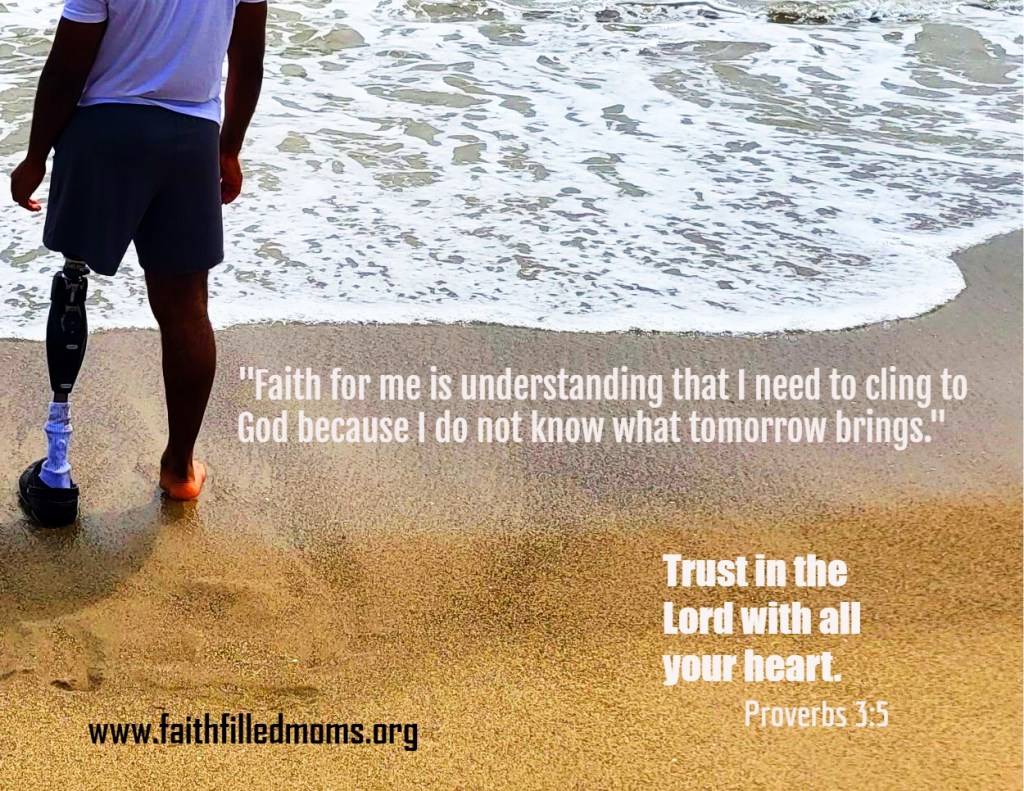
Faith for me is understanding that I need to cling to God because I do not know what tomorrow brings, nor do I control it. But I do know that I need Him to get through. Moreover, I trust that loving Him and believing in Him will help me to know that I am not alone and that I never will be.

Encouragement for Moms:
- Be patient with yourself. Receiving a cancer diagnosis for your child (or any loved one) is a traumatic event. Having unrealistic expectations for yourself, your child or any close family member will increase your anxiety and stress.
- Medical Trauma is a real experience. Give space for the diagnosed patient to have a variety of reactions as they undergo treatment.
- Find your people. People who will let you show up how you need to. People who will give you space to be angry, cry, or talk about reality television, if that’s what you want.
- Being a caregiver is hard and can be traumatic. Seek help and support for yourself.
- Consider using a blog site to help disseminate information so you do not have to repeat information to people who want updates.
- Remember that just because your needs have increased, does not mean that other people’s capacity to meet your needs has also increased. Try not to take it personally when certain people don’t show up.
Prayer for Moms:
Lord, despite what lies before us or behind us, remind us that you are always with us. You will never leave our side or our children’s side through this battle and any other that we encounter along the way. We pray to feel your presence and to be reminded that YOU are in control. That YOU have a plan and that YOU love us. Help us to cling to your side and be assured that we are in your hands.
In Jesus name, Amen.
Want to hear more of Patrice’s story? Watch our Moms Night In Conversation on YouTube.
Or watch here on our Faith-Filled Moms Facebook Page.

 Faith-Filled Moms